I went to TMAG expecting an hour, maybe ninety minutes. I left four hours later, and I still had not seen everything. If you take one thing from this post, take that: budget more time than you think you need.
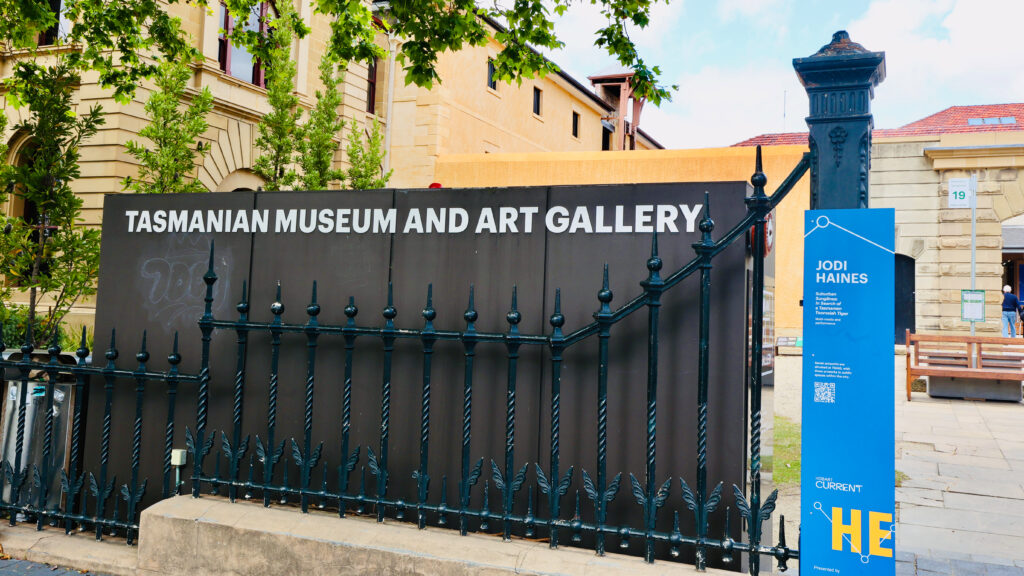 The main entrance signage for the Tasmanian Museum and Art Gallery in Hobart, with an exhibition banner for artist Jodi Haines visible alongside.
TMAG sits right on Hobart’s waterfront, a five-minute walk from Salamanca, built into a cluster of sandstone buildings that used to be part of the old Commissariat and Bond Store complex. Free entry, no ticket, no booking. You just walk in.
The quick answer
TMAG is Tasmania’s state museum and art gallery, free to enter, on the Hobart waterfront near Salamanca. Expect natural history, colonial art, a dedicated Thylacine Gallery, Antarctic and Southern Ocean exhibits, and rotating contemporary shows. Budget at least two hours, ideally half a day. Open daily from 10am to 4pm during January to March, and Tuesday to Sunday the rest of the year.
Finding it
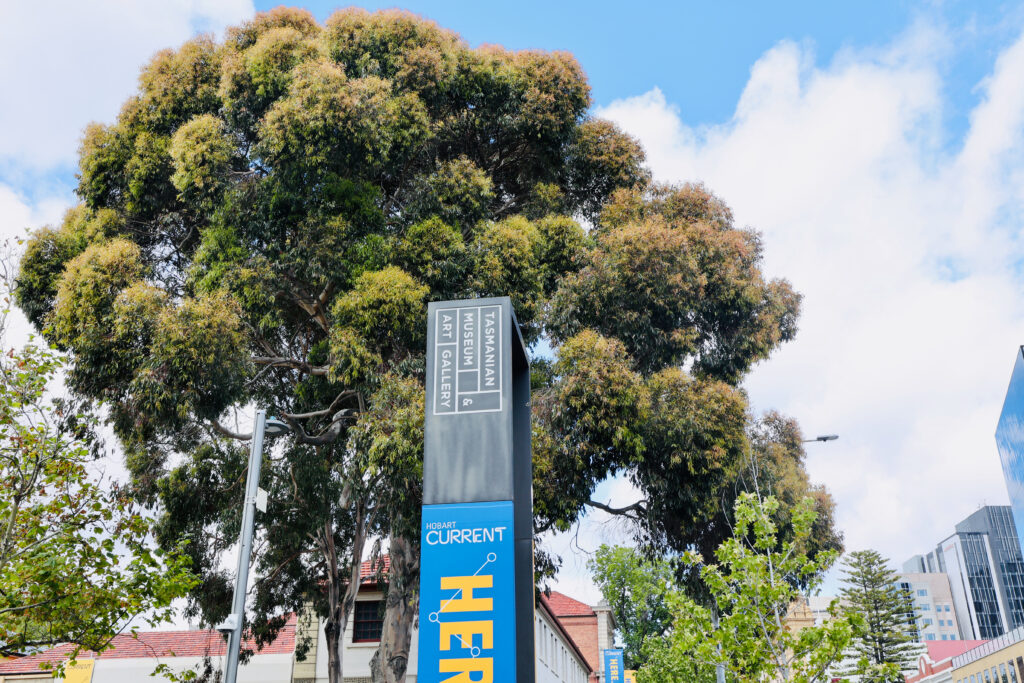 A signpost doing double duty as a Hobart Current marker
The entrance sits behind an iron fence on Dunn Place, with a simple directional sign pointing the way through the trees. When I visited, the sign was doubling as a marker for Hobart Current, a biennial contemporary art programme that runs across TMAG and public spaces around the city. More on that shortly, since it shaped a good chunk of what I saw that day.
The courtyard, and a dinosaur you were not expecting
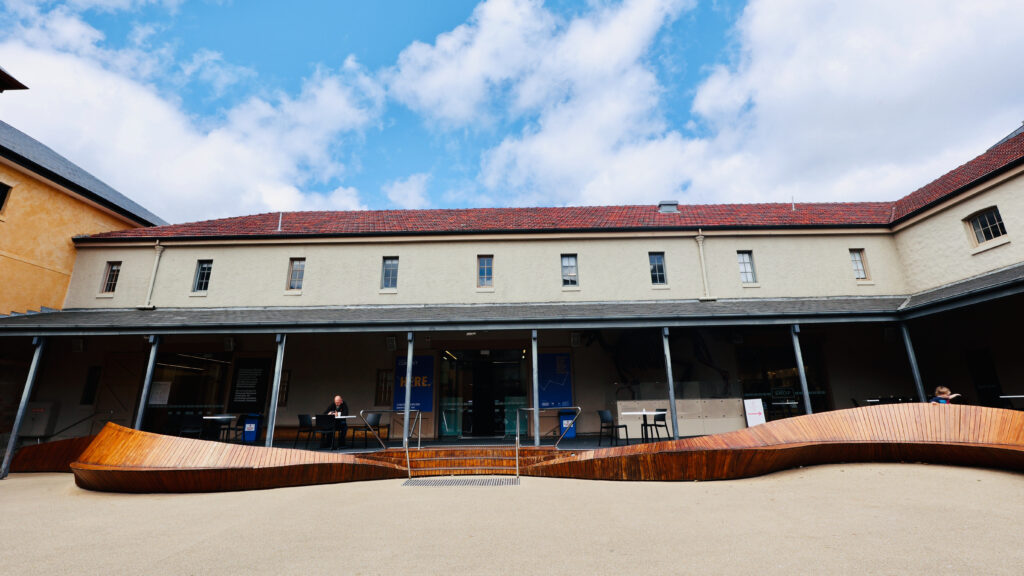 The courtyard that makes you want to sit down before you’ve even gone inside
Past the gate is a proper heritage courtyard, sandstone walls, a red tile roof, and a striking wave-shaped timber bench that doubles as a ramp down to the entrance. Cafe tables sit under the old verandah. It is a warm, welcoming first impression, the kind of space that makes you want to sit down before you have even gone inside.
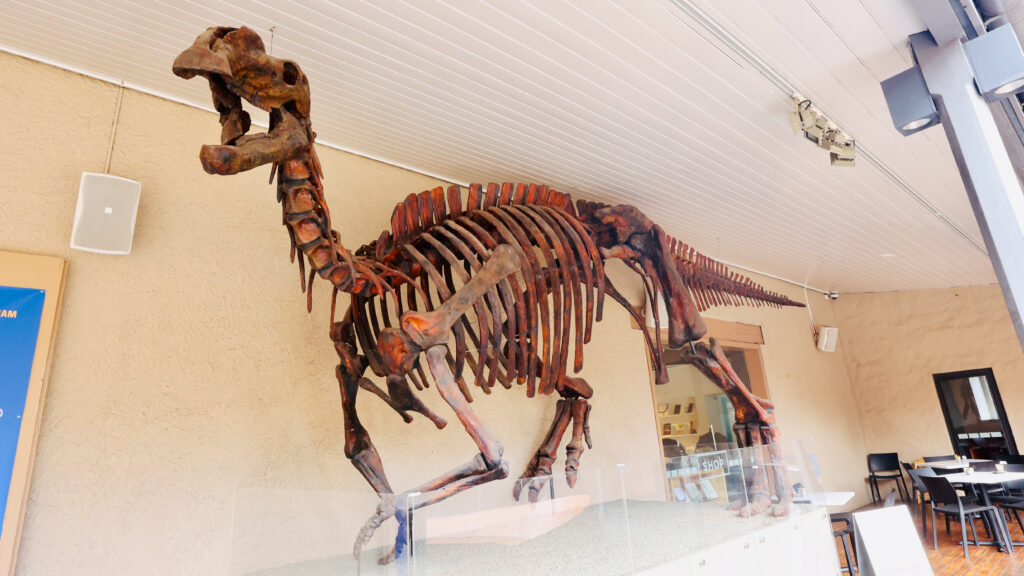 Not what you expect to see hanging over the museum shop
Then you notice the skeleton mounted above the shop entrance. A full dinosaur skeleton, reddish bone against the stucco wall, jaw open, tail extending along the ceiling line. I could not track down which species it is from my photos alone, and I would rather admit that than guess. Whatever it is, it is not what you expect to see hanging over a museum cafe, and it sets the tone for a place that does not take itself too seriously even while doing serious things.
Natural history and the Southern Ocean
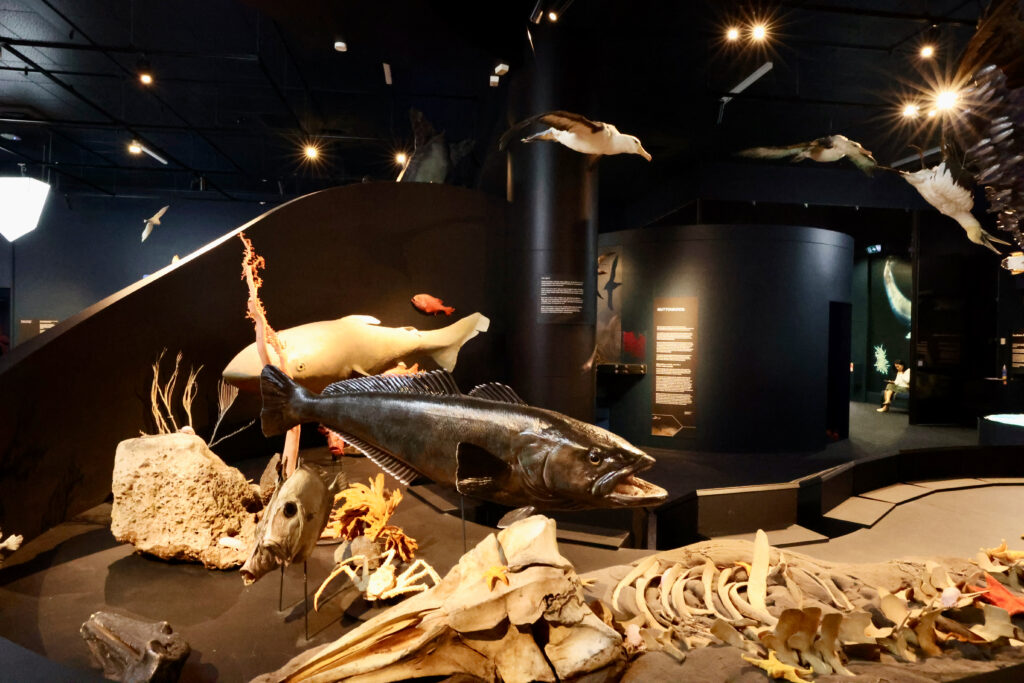 A Southern Ocean scene, muttonbirds overhead, whale bone underfoot
Inside, the natural history galleries lean hard into what makes Tasmania distinct. A marine diorama stopped me for a while, a dark predatory fish caught mid-hunt, a ray, whale bone fragments scattered across the display floor, taxidermied seabirds suspended overhead under a sign for muttonbirds, the short-tailed shearwaters that famously migrate along the Tasmanian coast.
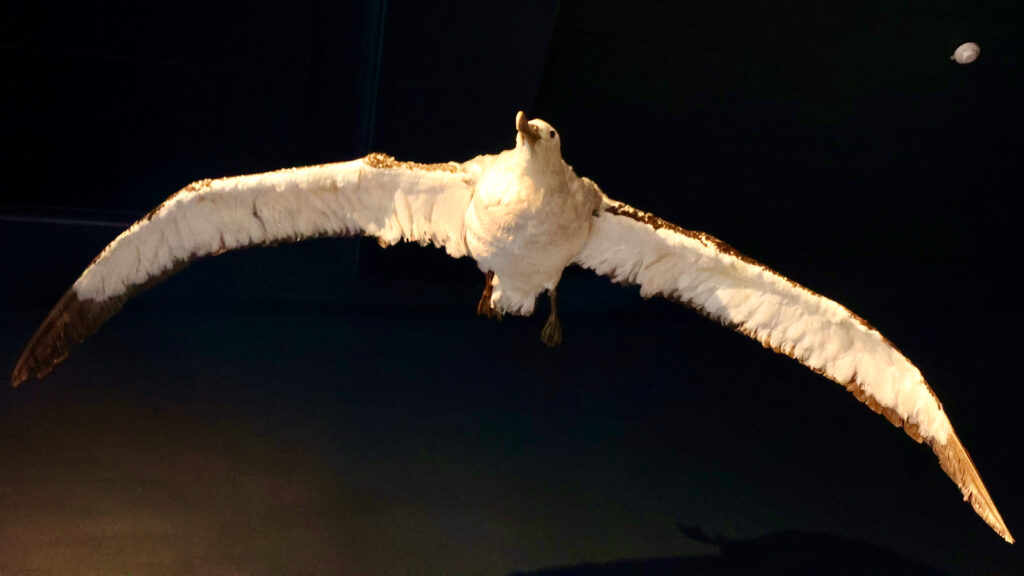 Wings fully extended, dramatically lit, hard not to photograph
A little further on, a single taxidermied albatross hangs mid-flight, wings fully extended, dramatically lit against black. It is a striking piece of museum design, the kind of thing you photograph without quite meaning to.
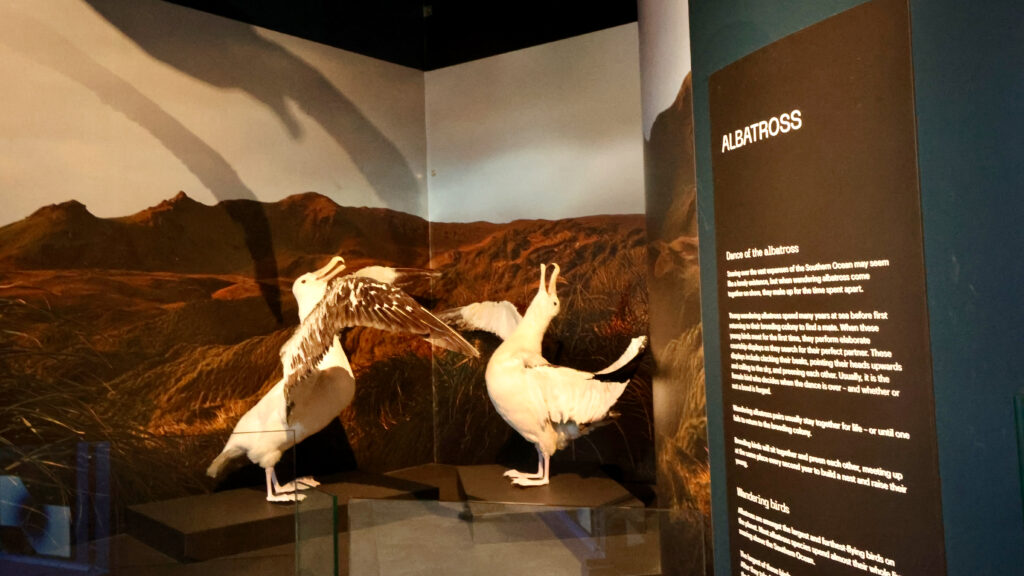 The dance of the albatross, a courtship ritual that can take years
Next to it, a pair of albatrosses face off in a courtship pose, beaks raised to the sky, wings half open. The panel beside them explains the ritual properly: young wandering albatrosses spend years at sea before returning to breeding colonies, where they perform elaborate courtship dances, beak clacking, sky-pointing, calling, and the female decides when the bond is made. Once paired, wandering albatrosses generally stay together for life. It is a small, quiet love story tucked into a natural history gallery, and it stuck with me more than I expected.
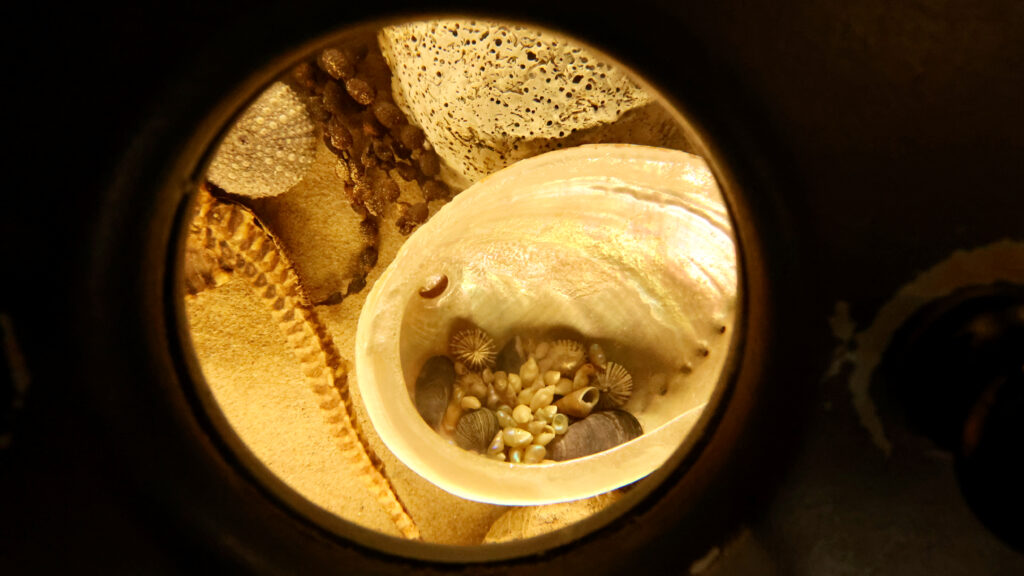 A frame within a frame, shells and specimens through a circular window
There is a case of shells and marine specimens too, viewed through a small circular window built into the display, an abalone shell catching the light, a sea urchin test, smaller shells scattered around it. It reminded me of the peephole shot from Kelly’s Steps, a frame within a frame, and I liked it for the same reason.
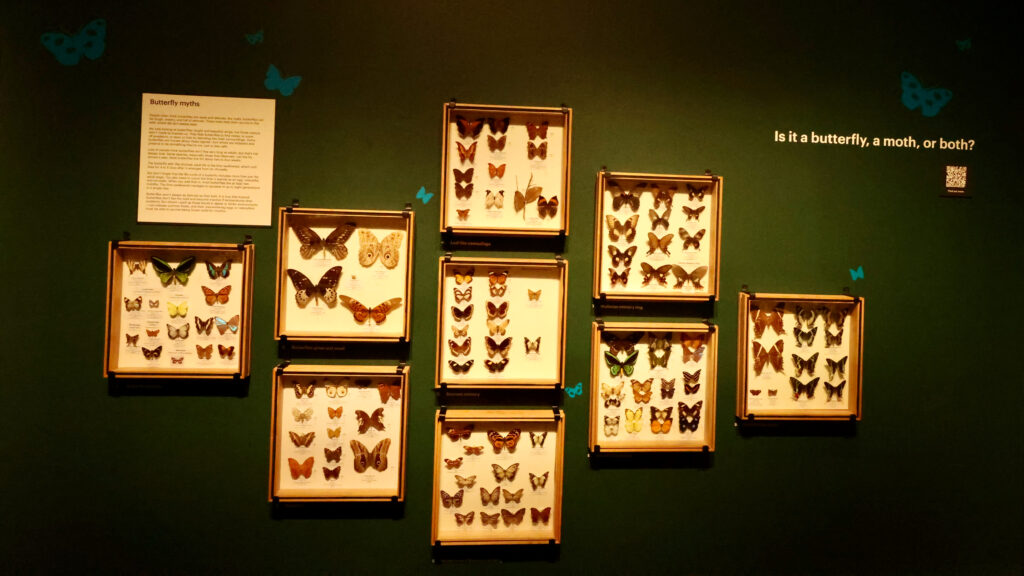 Wings pinned open, and a few butterfly myths debunked nearby
Elsewhere, a wall of mounted butterflies and moths runs across several display cases, wings pinned open in neat rows, with a panel called Butterfly Myths debunking a few things most people assume about them.
The Thylacine Gallery
This is the one I would flag hardest, even though I cannot tell you exactly what I saw or how long I spent there, my memory of the details has faded. But do not let that stop me from telling you it matters, because it does.
TMAG holds what is likely the most significant thylacine collection anywhere in the world, four taxidermy specimens, seven skins, a skeleton, pouched young preserved in alcohol, footprint casts, and video footage of thylacines filmed in captivity. The gallery is housed separately from the main natural history displays, in its own darkened room, closer to a memorial than an exhibit case.
A story worth knowing before you go
In 2022, researchers rediscovered the remains of the very last known thylacine, thought lost for over eighty years. It had been misfiled in the museum’s education collection rather than its zoological one, its skin quietly used for decades as a teaching aid for school groups. The animal died in Hobart’s Beaumaris Zoo in 1936. Its tanned skin and disarticulated skeleton are now on permanent display in TMAG’s thylacine gallery, finally identified for what they are.
There is also a persistent myth worth knowing, and un-knowing: the last captive thylacine is often called “Benjamin” in popular retellings. According to TMAG’s own honorary curator, that name was invented decades later by someone with no connection to the zoo. It has no basis in the historical record, though it keeps circulating anyway.
Antarctica, closer than it looks on a map
TMAG has a strong Antarctic and Southern Ocean thread running through its natural history galleries, and it connects to something worth knowing if you are visiting Hobart: this city is one of only five official Antarctic gateway cities in the world, alongside Cape Town, Christchurch, Punta Arenas, and Ushuaia.
Hobart is home port for RSV Nuyina, Australia’s Antarctic icebreaker, the same red-hulled ship I photographed without knowing it from Rosny Hill on my best sunset in Hobart evening. The Australian Antarctic Division is headquartered a short drive away in Kingston, and Hobart’s airport runs charter flights carrying personnel and equipment to Antarctic research stations. Geographically, Hobart sits closer to Antarctica than it does to Perth.
Can you actually travel to Antarctica from here as a tourist? Technically yes, a small number of expedition cruises and charter flights do depart from Hobart, but this is a niche route used mostly for research and private charter rather than mainstream tourism. The overwhelming majority of Antarctic tourism departs from Ushuaia in Argentina, since the crossing from South America is roughly a third of the distance. If reaching Antarctica itself is the goal, Ushuaia remains the practical choice. What Hobart gives you instead is proximity to the story, the ships, the research institutions, and museums like TMAG that put the whole picture together without needing a polar expedition budget.
If the Antarctic connection interests you, the Mawson’s Huts Replica Museum sits on the waterfront too, close to where Douglas Mawson’s Australasian Antarctic Expedition actually departed in 1911. I did not visit it myself on this trip, but it is an easy add-on given how close it sits to TMAG.
Art, portraits, and a chandelier in a dim hallway
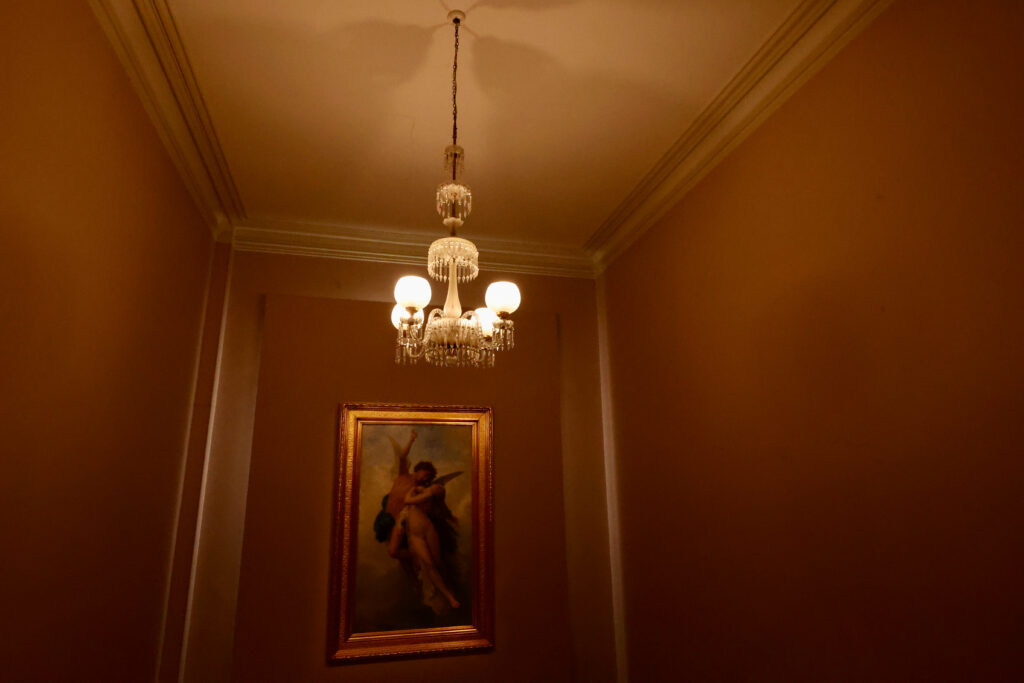 A crystal chandelier glowing over a single dramatic painting
Away from natural history, TMAG’s art galleries hold a proper collection of colonial and contemporary Tasmanian work. One quiet hallway had an antique crystal chandelier glowing above a single large gilt-framed painting, a winged figure carrying a nude figure through clouds, dimly lit, almost theatrical.
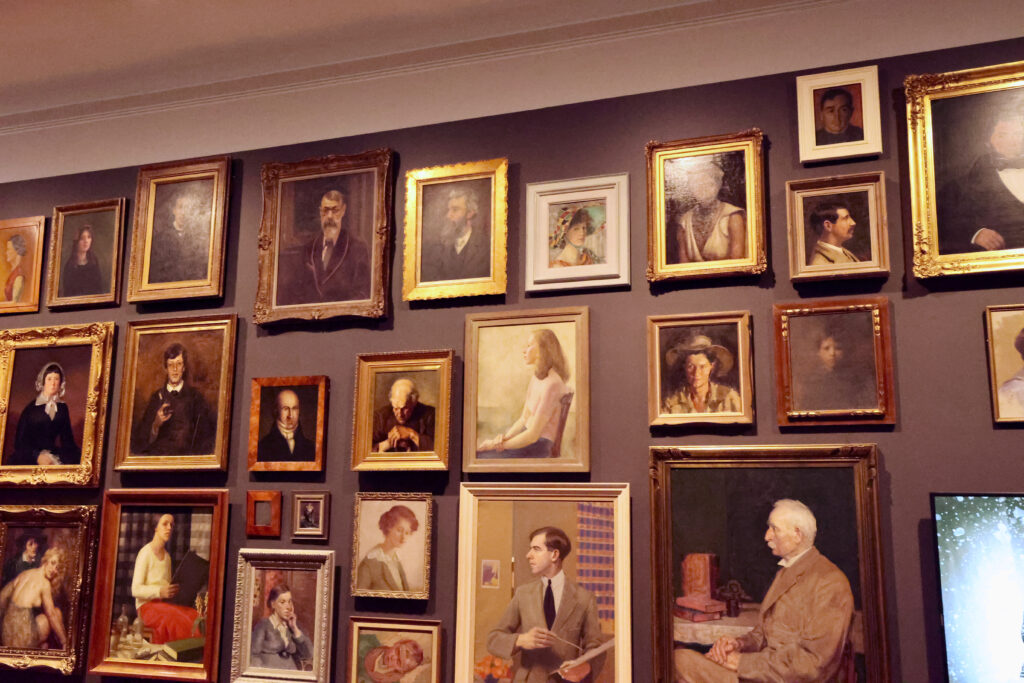 Two centuries of Tasmanian faces, stacked floor to ceiling
A nearby room holds a dense salon-style wall of portraits, dozens of framed faces stacked floor to ceiling in the traditional hang style, gilt frames next to plain wooden ones, a real cross-section of who has been painted in Tasmania over the last two centuries.
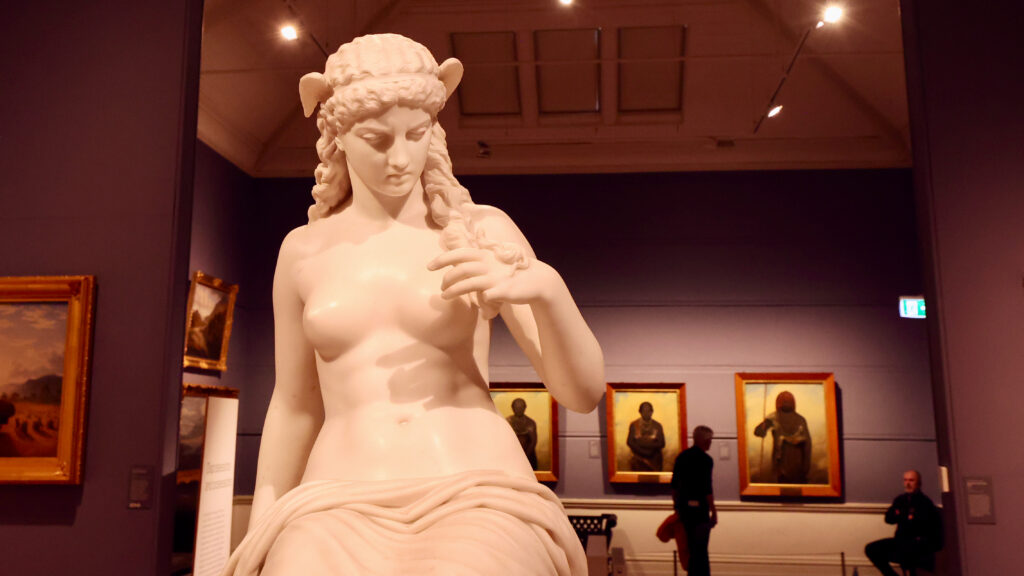 A classical marble figure holding court among colonial landscapes
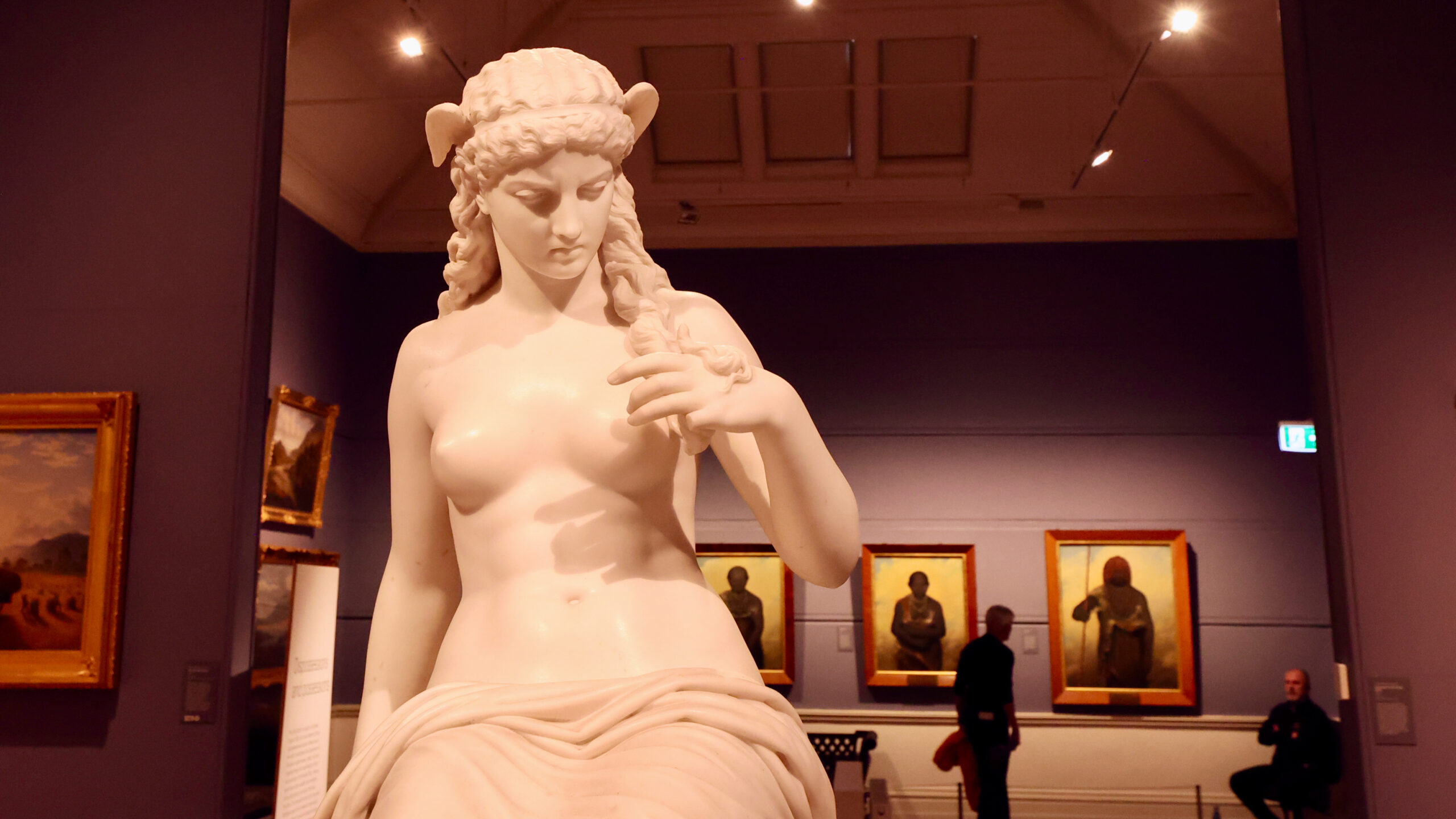
In another gallery, a classical marble sculpture of a seated female nude sits at the centre of the room, colonial landscape paintings lining the walls behind her, visitors moving quietly around the space.
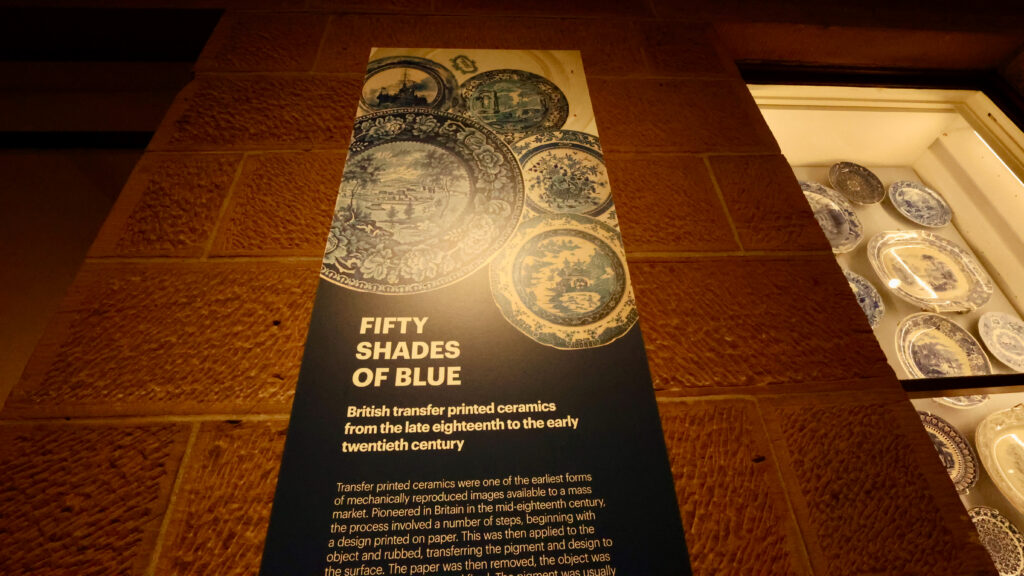 Fifty Shades of Blue, two centuries of British transfer-printed ceramics
And tucked into one of the sandstone alcoves, a temporary display called Fifty Shades of Blue caught my eye, British transfer-printed ceramics from the late eighteenth to early twentieth century, blue and white plates layered in a lit display case against the rough stone wall. Exhibitions like this rotate, so it may not be showing when you visit, but it is a good example of how TMAG uses its smaller nooks and alcoves for focused, well-curated shows rather than leaving them empty.
Hobart Current: contemporary art woven through the building
During my visit, TMAG was hosting Hobart Current: Here, the third edition of a biennial contemporary art programme run jointly by TMAG and the City of Hobart, showing from November 2025 through to late April 2026. Ten Tasmania-based artists contributed work spanning performance, sculpture, video, and installation, spread across the museum and public sites in the CBD.
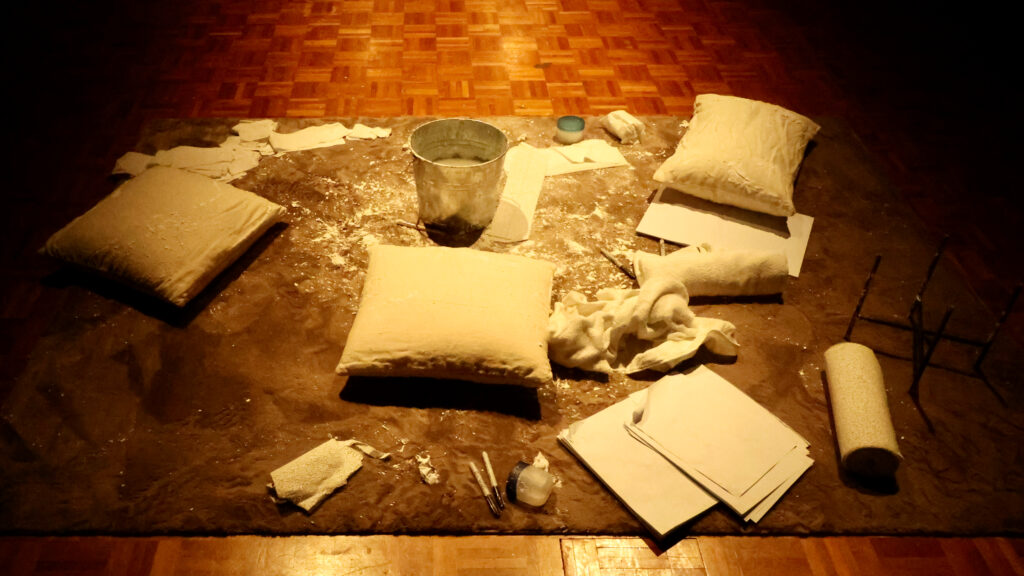 A contemporary art floor installation of plaster-cast forms at the Tasmanian Museum and Art Gallery, part of the Hobart Current exhibition programme.
One piece I photographed without fully understanding it at the time was Jodi Haines’ Suburban Songlines, a multi-media and performance work responding to the thylacine, fittingly close to the museum’s own thylacine gallery. Elsewhere in the museum, I came across a striking floor installation of pale plaster-cast pillow forms scattered across a stained tarpaulin, cream fabric shapes, a metal bucket, tools laid out nearby. It is very likely Body Shells by Jenni Large, a durational performance piece using plaster body casts, though I cannot say for certain without having seen the full exhibition label.
If you visit while Hobart Current is running, it is worth actively looking for these works rather than assuming everything you see is part of the permanent collection. If you visit after April 2026, this specific layer will be gone, replaced by whatever comes next.
MONA: the other Hobart museum
TMAG and MONA get mentioned in the same breath constantly, and for good reason, they are almost opposites of each other. Where TMAG is free, sandstone, and rooted in natural and colonial history, MONA is ticketed, subterranean, and built entirely around one collector’s confronting, provocative private collection.
MONA, the Museum of Old and New Art, opened in 2011 at Berriedale, about thirteen kilometres north of the CBD, and quickly became the largest privately funded museum in the Southern Hemisphere. It was created by Tasmanian gambler and mathematician David Walsh, who has described it as “a subversive adult Disneyland.” There is no signage inside, no explanations on the walls, visitors use a device called The O to find out what they are looking at as they wander through a properly disorienting underground labyrinth. Themes of death and sex run through a lot of the collection, so it is not really a museum for young children, whatever the ticket policy says.
The journey there is part of the appeal. The MONA Roma ferries, camouflage-painted catamarans, depart from Brooke Street Pier on the Hobart waterfront and take around twenty five to thirty minutes up the Derwent, arriving at a ninety nine step staircase built into the hillside, deliberately modelled on a Greek temple approach. General admission runs about $39 for adults, with the ferry booked separately. Locals, cheekily, get in for a token fee. Plan for at least three to five hours once you are there, more if you are eating or drinking on site.
Booking MONA
Ferry and entry can be booked directly, or bundled with transport and other Hobart sights if you would rather not sort the logistics yourself.
Book MONA tickets and experiences here
The children’s gallery and the building itself
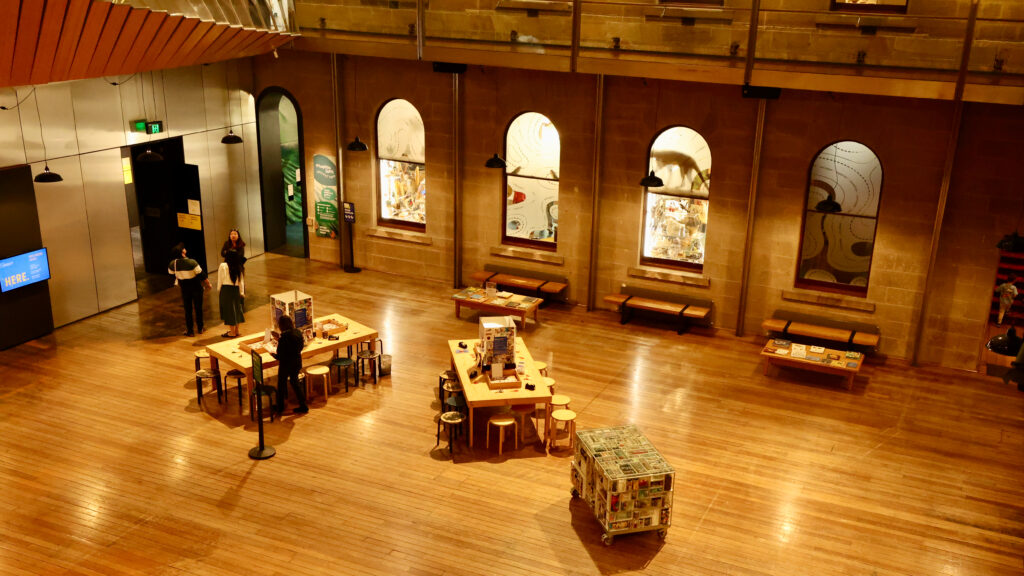 The mapiya lumi children’s gallery at the Tasmanian Museum and Art Gallery, Hobart, with hands-on craft tables and a mosaic-covered sculpture.
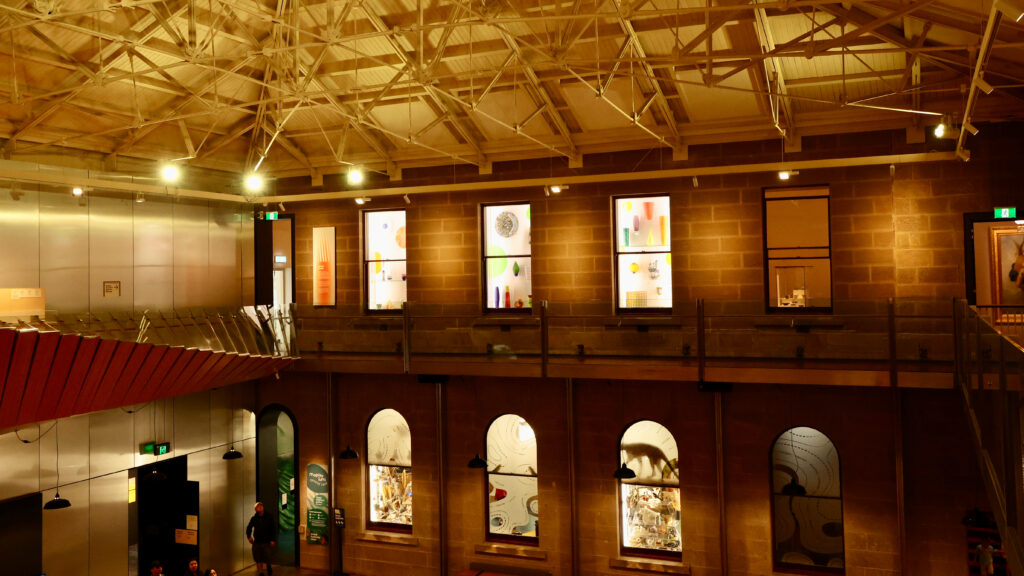
TMAG’s architecture deserves its own mention. One large hall, signed mapiya lumi, meaning roughly “around here” in palawa kani, the Tasmanian Aboriginal language, functions as a hands-on children’s gallery. Polished timber floors, low craft tables with stools, a mosaic-covered cube sculpture on wheels, illuminated display windows built into the original sandstone wall.
 The building doing as much storytelling as anything inside the cases
Above it, the original heritage roof trusses are still exposed, timber and iron bracing crossing overhead, with a mezzanine level running around the room showing glass and ceramic pieces lit in individual arched window recesses. The building itself is doing as much storytelling as anything inside the cases.
The view you get for free
 Constitution Dock, framed by accident through the window
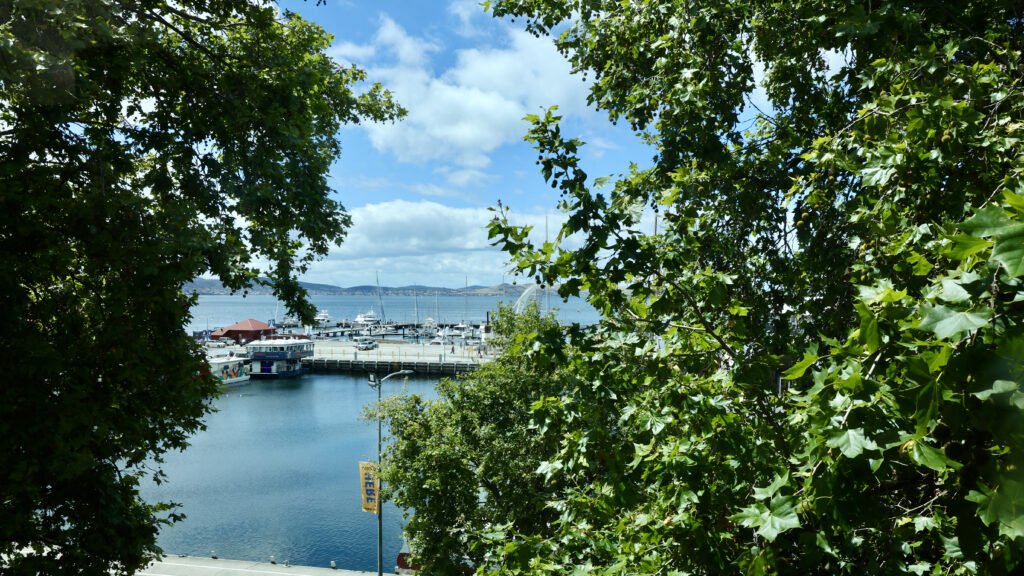
One of the nicest surprises was looking out rather than in. Framed through plane tree branches from an upper window, Constitution Dock spreads out below, moored yachts, a colourfully painted tour boat, and a white sculptural arch near the water’s edge, with hills rising across the Derwent in the background.
Practical info
Cost: Free. No ticket required for general admission.
Hours: Daily 10am to 4pm from January through March. Tuesday to Sunday the rest of the year, closed Mondays outside peak season.
How long to spend: Budget a minimum of two hours if you are moving quickly. I spent about four hours and still did not see everything. If you are a slow museum walker who reads every panel, set aside half a day.
Photography: Allowed for personal use throughout most of the museum, though flash and tripods are not permitted, and a small number of areas restrict photography, so check on-site signage as you go.
Facilities: Free cloaking for bags and umbrellas at the visitor desk, a shop, and a courtyard cafe.
Getting there: A five-minute walk from Salamanca Place, right on the waterfront. If you are doing the Salamanca to Battery Point walk, TMAG makes a natural add-on either before or after.
FAQ
Is TMAG free to enter?
Yes. Free general admission, no ticket required.
How long should I spend at TMAG?
At least two hours. Half a day if you want to see everything properly, including the Thylacine Gallery, natural history displays, and art collections.
What are TMAG’s opening hours?
10am to 4pm daily from January to March. Tuesday to Sunday the rest of the year, closed Mondays outside that peak window. Always check the current TMAG website before visiting, as hours can shift.
Does TMAG have a real thylacine on display?
Yes. TMAG holds the world’s most significant thylacine collection, including taxidermy specimens, skins, a skeleton, and the rediscovered remains of the last known captive thylacine, on display in a dedicated gallery.
Can you travel to Antarctica from Hobart?
Hobart is one of five official Antarctic gateway cities, home port to Australia’s icebreaker RSV Nuyina and the Australian Antarctic Division. A small number of expedition cruises and charter flights depart from here, but it is a niche route. Most Antarctic tourism departs from Ushuaia in Argentina, which sits much closer to the continent.
Is TMAG suitable for children?
Yes. There is a dedicated children’s gallery called mapiya lumi with hands-on activities, and the natural history displays generally hold kids’ attention well.
Is TMAG near Salamanca Market?
Yes, it is a five-minute walk from Salamanca Place, making it an easy add-on to a Salamanca or Battery Point walk.
Should I visit MONA and TMAG on the same trip?
They make a good contrasting pair. TMAG is free, natural history and colonial art. MONA is ticketed, contemporary, and deliberately provocative. Many visitors do TMAG in a morning and take the ferry out to MONA in the afternoon, or split them across separate days.
Final thoughts
I did not plan for TMAG to take up an entire afternoon, and I would not change it if I went back. Free museums rarely earn four hours of anyone’s holiday time, but this one did, and it left me with a thylacine story I still think about and a slightly better understanding of why Hobart keeps turning up in conversations about Antarctica.
If you are building out your own Hobart days, the Salamanca to Battery Point walk sits right next door and pairs naturally with a TMAG visit either side of it. For an evening after, the best sunset spots in Hobart are a short trip across the bridge, and if you are chasing the mountain, the Mount Wellington guide covers that separately. Once it is live, our 3 Days in Hobart itinerary (link when live) will pull all of these into one plan.
Please visit:
Our Sponsor
Related Posts
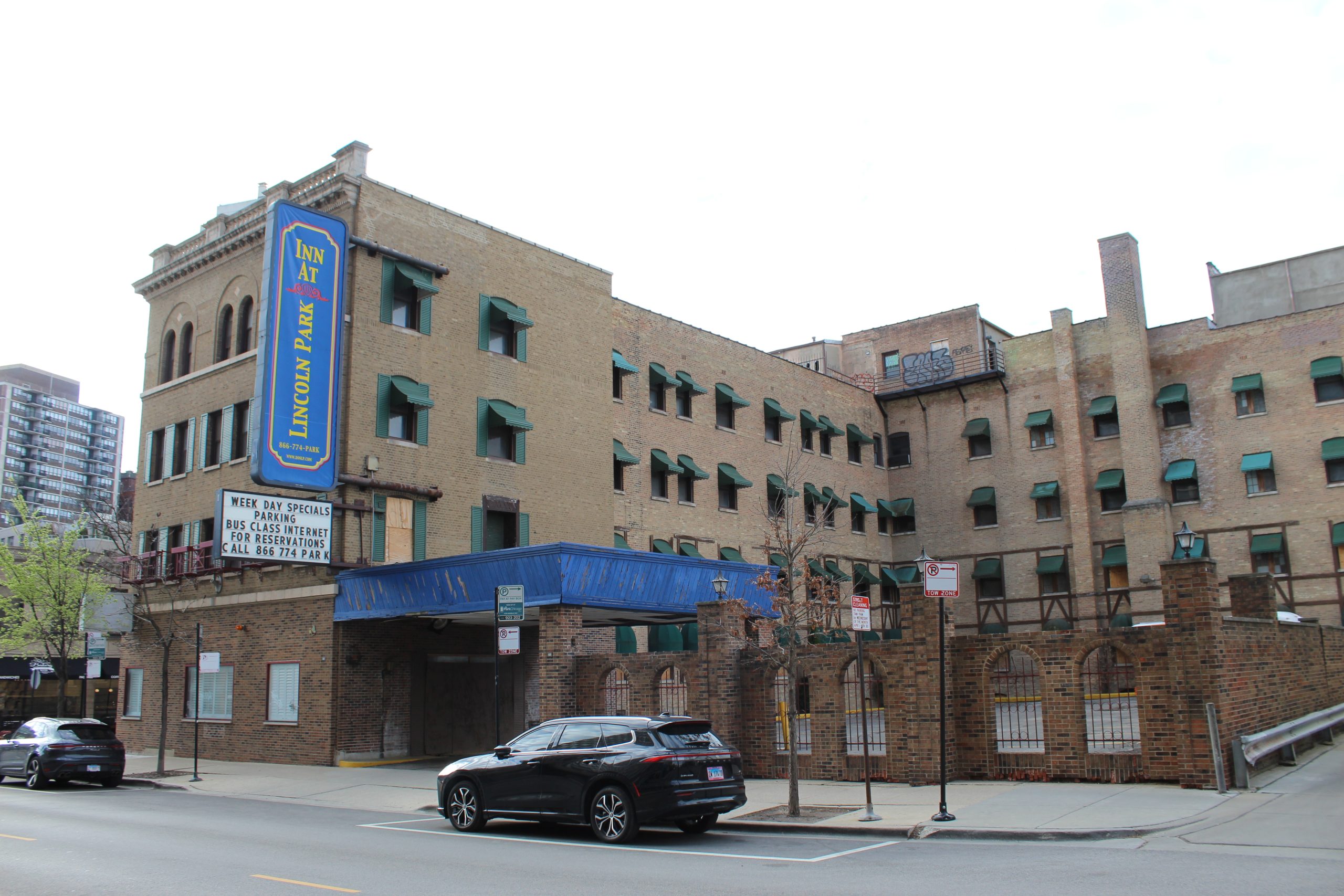
Century-Old Lincoln Park Hotel Could Become Apartments Under Redevelopment Plan
LINCOLN PARK — A century-old former hotel would be converted…

GBTA Foundation Launches SAF Corporate Connect to Accelerate Sustainable Aviation Fuel Adoption in Business Travel
NEW YORK, NY – Air travel remains one of the…
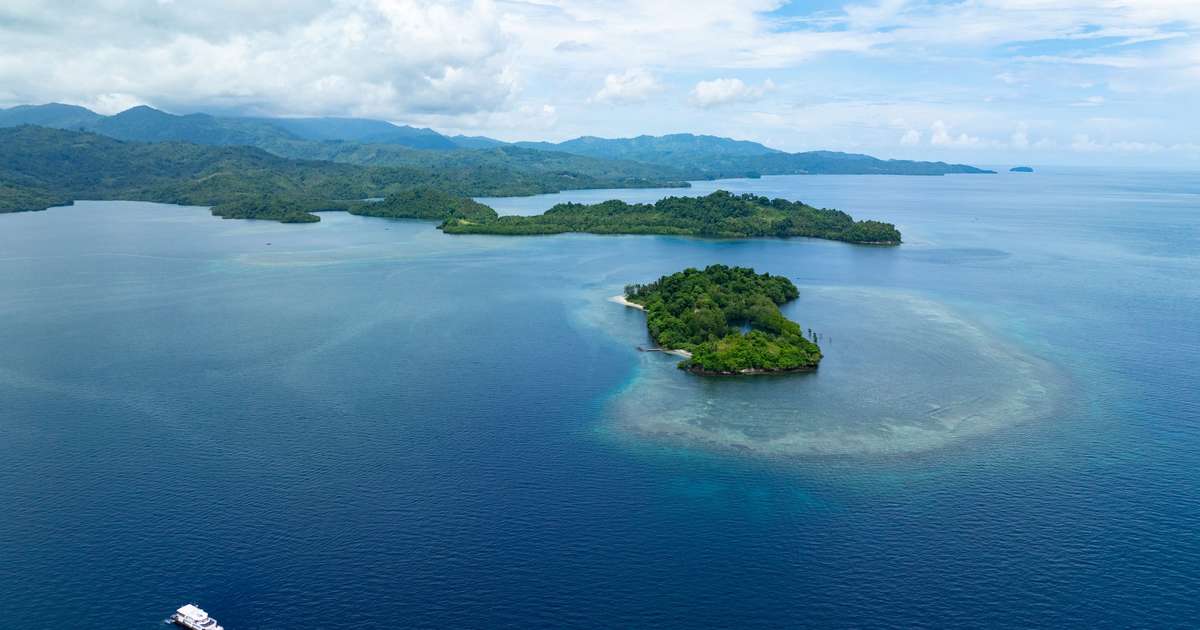
Pioneering New Horizons: Club Med Announces New Resort in Manado, Indonesia, Expanding its Southeast Asia Portfolio
Club Med, leader in premium all-inclusive holidays for 75 years,…