By Joan Torres Leave a comment Last updated on November 10, 2026
Stretching all the way to China, and separating Pakistan from Tajikistan, the Wakhan Corridor is a narrow strip of land in eastern Afghanistan, considered one of the remotest regions in all of Central Asia, and certainly one of the most jaw-dropping.
This is a complete travel guide to the Wakhan Corridor, which will tell you everything about visas, permits, getting in, hiking tips and a complete 15-day itinerary.
For general information on the country, read our Afghanistan travel guide.
Travel to the Wakhan Corridor in Afghanistan with ATC
Join the ATC Community in our next expedition to the Wakhan Corridor, the remotest region in Central Asia
UPCOMING TOUR
Aug 17th to 31st (2027)
ITINERARY
Tajikistan > Border Crossing > Afghanistan > Kunduz > Ishkashim > Wakhan Corridor

In this travel guide to the Wakhan Corridor you will find:
Our recommended travel insurance for the Wakhan Corridor
IATI Insurance is one of the very few travel insurance providers that offers coverage for travel to Afghanistan + trekking in high altitude (with Backpacker plan)
Trusted by ATC
Coverage for Wakhan Corridor
Exclusive 5% discount for our readers
🇦🇫 Why travel to the Wakhan Corridor in Afghanistan
Created in 1893 to serve as a buffer between the Russian Empire (today’s Tajikistan) and British India (today’s Pakistan), the Wakhan Corridor had long been crossed by travelers moving along ancient Silk Road routes, a history still visible in the old forts and caravanserais scattered along the Panj River.
Then came modern borders.
China, Pakistan and the Soviet Union became virtually inaccessible from the Afghan side, cutting off communities that had historically interacted and traded across these mountains and valleys.
The Wakhan became increasingly isolated from the outside world, eventually turning into one of the remotest inhabited regions on the planet.
There’s something difficult to describe about trekking at 4,000 meters above sea level and suddenly coming across a group of nomads and shepherds in the middle of nowhere.
For me, it’s one of the best feelings in the world.
If I had to list my top five places to travel, the Wakhan Corridor in Afghanistan would certainly be one of them.
- Wakhi people Afghanistan – A Wakhi family from a remote mountain settlement
️ Tours to the Wakhan Corridor
We like to encourage people to venture into remote destinations independently. That’s what our travel guides are for.
However, we also know that planning a trip through the Wakhan Corridor takes a lot of time, especially when it comes to logistics.
At Against the Compass, we run a Wakhan Corridor Expedition once a year:
A 15-day adventure starting in Dushanbe and traveling all the way to Chaqmaqtin Lake, including a five-day hike.
Our next dates in 2027 are:
- Tours in the Wakhan Corridor – Group photo (including porters and guides) from our last expedition
🪪 How to get a visa for Afghanistan
You will need a visa to travel to the Wakhan or anywhere else in Afghanistan, and we have written about it in detail in the visa section of our Afghanistan travel guide.
However, in summary, if you are traveling to Afghanistan to visit the Wakhan, you will probably enter overland from Tajikistan at the Shir Khan border.
At this specific entry point, an Afghan visa is available on arrival, provided that you complete this online form beforehand and pay 100 USD upon arrival.
If you are entering Afghanistan through Kabul, you can obtain an e-visa.
For more information, check the visa section of our Afghanistan travel guide.
- Visa for Afghanistan – The new visa format for Afghanistan
How to get your permits for traveling to the Afghan Wakhan Corridor
To be honest, permits are required to travel throughout Afghanistan, and obtaining them as an independent traveler has become increasingly difficult.
Basically, you will need a specific permit for any province where you are staying for at least one night. This means that if you are only passing through, you don’t need one, but you must obtain one if you are staying overnight.
For more information, it’s best to refer to the permits section of our Afghanistan travel guide, where you can find all the details.
Coming back to the permits needed for the Wakhan, you’ll first need the general permit for traveling across Badakhshan Province.
This permit can be obtained from the Ministry of Information and Culture office in Fayzabad, the capital of Badakhshan Province.
In Badakhshan Province, however, due to its sensitivity (it is considered a rebel area against the Taliban) another permit issued by the local military is required.
This permit can be obtained at the military base in the town of Baharak, located one hour from Fayzabad.
Nevertheless, this permit might not be requested or required if you are traveling there independently, you just never know.
For our ATC group, it was 100% mandatory, but in Ishkashim, I met a Canadian traveler who had made his way there with only the general Badakhshan permit.
Is it safe to travel to the Afghan Wakhan Corridor?
Afghanistan has always been a sensitive destination.
Honestly, security on many roads has improved dramatically since the Taliban returned to power in 2021, but safety is always relative.
The Wakhan has long been considered the safest part of Afghanistan. Its isolation largely spared it from the fighting that affected much of the country, and travelers continued to visit even during the civil war.
Today, there are occasional clashes between the Taliban and armed opposition groups in Badakhshan Province.
These clashes are between the groups themselves, and neither side has shown any particular hostility towards foreign travelers.
Badakhshan is also a huge province, and the recent clashes have taken place hours away from the places travelers visit.
However, at the end of the day, it’s up to each traveler to assess the risks and decide whether the journey is worth taking.
- Is the Wakhan safe to travel? – An armed Taliban soldier
Travel insurance for Afghanistan

Most travel insurance companies don’t cover travel in Afghanistan, except for IATI Insurance.
At Against the Compass, we’ve worked directly with IATI since 2016. They’re our oldest and most trusted partner, the insurance provider I use when traveling to the remotest destinations, and the one we use for our group expeditions.
Here’s why we recommend IATI for traveling in the Wakhan Corridor:
- They offer coverage for travel in Afghanistan.
- Their Backpacker plan covers trekking at high altitude, which you’ll need for the Wakhan.
- They offer good value for money, with some weekly plans starting at €30.
- They have different plans for different types of travelers.
- ATC Readers & Travelers get a 5% discount.
️ Best time to visit the Wakhan Corridor in Afghanistan
Summer is the best time to travel across the Wakhan.
The Wakhan Valley is a high-altitude area of Afghanistan, with the first Wakhi town already at 2,600 metres above sea level and Chaqmaqtin Lake at 4,024 metres.
If you’re planning to hike to the lake through the Little Pamir, you’ll be sleeping above 4,000 metres almost every night, with mountain passes reaching up to 4,950 metres.
This means the hike can only be attempted in summer. However, villages along the Panj River, including Ishkashim and Qala-e-Panja, can be visited year-round, assuming the roads are clear of snow.
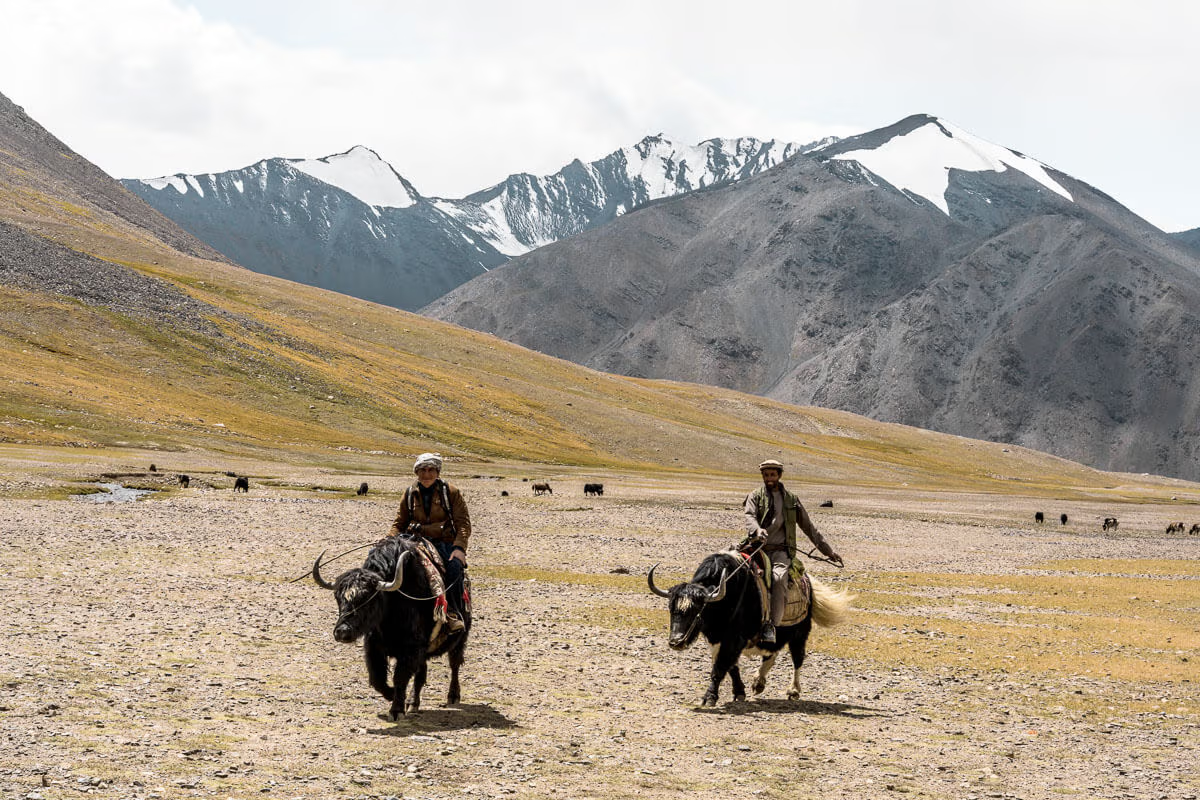
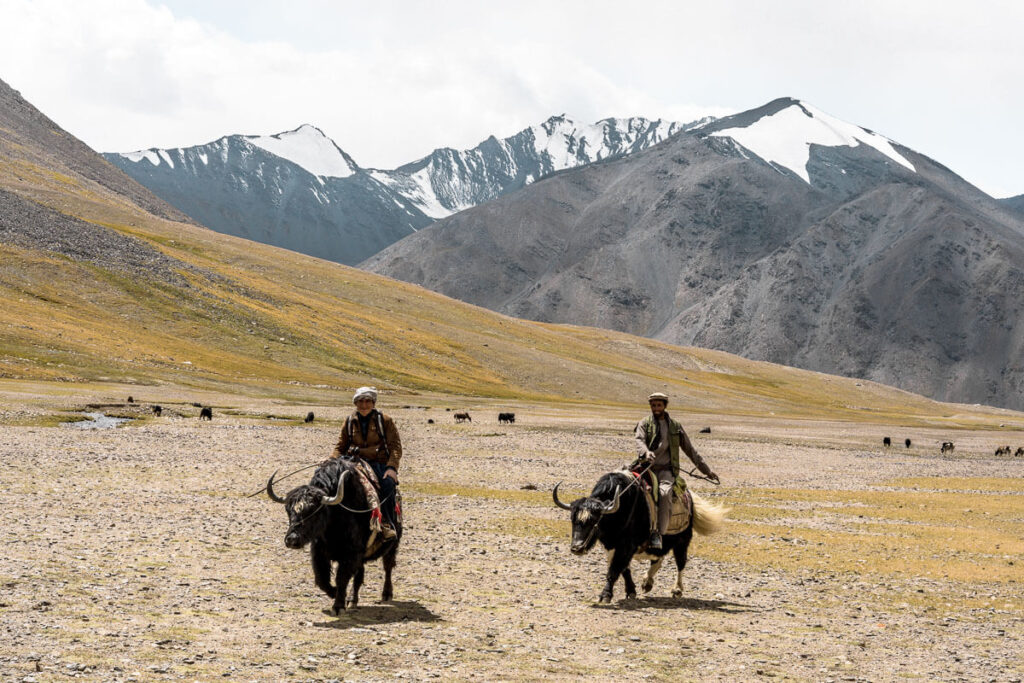
- Yaks Central Asia – In summer, yaks are in the high pastures
️ How to get to the Wakhan Corridor
The Wakhan Corridor is one of the remotest areas in the world, and getting there takes a lot of time, usually several days.
The quickest way to get there is by crossing into Afghanistan from Tajikistan.
Until 2023, it was possible to cross into Afghanistan at Ishkashim, located in the Tajik Wakhan Valley and a popular stop along the Pamir Highway.
However, relations between Tajikistan and Afghanistan aren’t great, which is why they decided to close that border crossing while keeping Shir Khan, located near the city of Kunduz, open.
It takes more than 12 hours to get from Kunduz to Ishkashim, a journey that should be split over at least two days.
Can I get to the Wakhan Corridor from Kabul?
Yes, you can, but since there’s no functional airport in Kunduz or Badakhshan, you’ll have to add another nine-hour drive to your route for the journey from Kabul to Kunduz.
In any case, Ishkashim is the first and main village in the Wakhan Valley, but from there, you still need to drive for at least two days along a very rough road to reach the national park entrance, the actual Wakhan Corridor.
How to deal with the Taliban in the Wakhan Corridor
In our Afghanistan travel guide, we do have a section explaining how to deal with the Taliban when traveling across the country.
In the Wakhan Corridor, however, things are a little different.
As you may know, Badakhshan province has always been an anti-Taliban stronghold. In fact, during the first Taliban takeover, they never came under Taliban rule, until the second takeover in 2021.
Today, while Badakhshan is Taliban-controlled, as is just about everywhere else in the country, many Tajik, Wakhi and Kyrgyz locals are unhappy with a centralized Pashtun government. That’s why clashes between the Taliban and local rebels are not unheard of.
In order to calm the local population without losing control of the province, Taliban members in Badakhshan are hired locally, usually Wakhis and Tajiks from villages along the valley. They are known by the local people.
In practical terms, as a traveler, you’ll notice that the Taliban at checkpoints are more relaxed, even more permissive.
A simple example is that they won’t say anything if your driver plays loud music in his van. They’re also somewhat more relaxed when it comes to foreign women and their hijabs.
For a further understanding of the Taliban in Afghanistan, remember to check our travel guide.
- Taliban man – A friendly local Taliban
How to get around the Wakhan Corridor
This section is for independent travelers.
It’s now possible to travel by vehicle beyond Sarhad-e Broghil towards Chaqmaqtin Lake, although the road is rough and conditions can change.
The road project began before the Taliban returned to power and was later continued by their government, largely in the hope of creating a direct trade route between Afghanistan and China.
For travelers, the road means you no longer have to trek for several days to reach Chaqmaqtin Lake.
Ishkashim is the gateway to the Wakhan Corridor.
From Fayzabad, you can generally find minivans or shared taxis to get there.
Beyond Ishkashim, villages are farther apart and transport becomes much less frequent.
Shared taxis may run towards Qala-e Panja and Sarhad-e Broghil, but they usually leave only when they have enough passengers. Cars may not leave every day.
Hitchhiking is certainly feasible, but traffic can be sparse, so don’t rely on getting a lift at a particular time.
Beyond Sarhad-e Broghil, there are no regular shared taxis to Chaqmaqtin Lake. You can arrange a vehicle or walk there, which takes roughly three to six days depending on your route.
- Getting around the Wakhan – The minivans that run from Fayzabad to Ishkashim
The people in the Wakhan Corridor
The mountains may be what first draws you to the Wakhan, but the people are what make the journey memorable.
The people along that region are exceptionally kind and hospitable, and meeting Wakhi villagers and Kyrgyz herders gives a glimpse of daily life in one of the most remote parts of the world, where farming and herding traditions remain central to life here, shaped by the demands of the harsh landscape.
The Wakhi
Most villages along the Wakhan Valley are home to the Wakhi. They speak Wakhi, and most follow Ismaili Islam, a branch of Shia Islam.
In my experience, social customs in Wakhi villages felt more relaxed than in many other parts of Afghanistan, particularly around interactions between men and women.
- The Wakhi – Another Wakhi family somewhere the Wakhan valley
The Kyrgyz
Farther east, in the Little and Big Pamir, live the Afghan Kyrgyz. They are Sunni Muslims who speak a Turkic language and traditionally move with their herds between seasonal pastures.
Around Chaqmaqtin Lake, you will come across their small settlements and yurts at roughly 4,000 metres above sea level.
Life here is very different from that in the Wakhi farming villages farther down the valley.
Read: A travel guide to Kyrgyzstan
- Kyrgyz people Afghanistan – A Kyrgyz woman milking a yak in Caqmaqtin
Internet in the Wakhan Corridor
Is there Wi-Fi anywhere along the Wakhan?
There’s relatively decent Wi-Fi (by Afghan standards) in the hotels in Fayzabad and the guesthouses in Ishkashim.
Beyond Ishkashim, you won’t find any Wi-Fi.
Can I connect to the internet with a SIM card?
Local SIM cards work as far as Ishkashim, including eSIMs, although the internet is often very slow. Airalo offers an eSIM for Afghanistan.
Along the Panj River, just across from Tajikistan, my physical Tajik Megafon SIM was getting 3G reception.
Where is there absolutely no connectivity?
After Qala-e Panja, when you leave the Panj River behind and head deeper into the corridor, there’s no internet connection. If you go hiking, there’s no phone reception either.
From the moment we left Qala-e Panja until we returned from our hike to Chaqmaqtin Lake, we spent almost nine days without internet service. It was amazing.
Where to stay along the Wakhan Corridor
Accommodation gets more basic as you travel deeper into the Wakhan.
In Fayzabad and Kunduz, you can stay in hotels but farther east, options are limited to local homestays.
During the hike to Chaqmaqtin Lake, you’ll need to camp.
These are the places I stayed:
️ Hiking in the Wakhan Corridor
The Wakhan Corridor is home to some of the most spectacular trekking in Central Asia, but hiking here takes a lot of preparation.
Once you leave Sarhad-e Broghil, you’ll be walking for days at high altitude, camping along the way and carrying everything you need.
Here are a few things to know.
Little Pamir or Big Pamir?
These are two high-altitude regions beyond the Wakhan Valley.
The Little Pamir lies farther east and includes Chaqmaqtin Lake and Kyrgyz settlements. The Big Pamir lies farther north, towards Zorkul Lake.
Both are equally remote, but the Big Pamir offers longer trekking routes. I’ve only been to the Little Pamir, which is the route described below, from Sarhad-e Broghil to Chaqmaqtin Lake.
- Hiking in the Wakhan Corridor – Hiking in Afghanistan, drone pic
How difficult is the hike?
The hike isn’t technical, but it’s still demanding.
On our route through the Little Pamir, we walked around 12–21 km a day, with some days involving close to 1,000 metres of ascent. We also crossed a pass at about 4,895 metres.
The distance isn’t the hardest part. It’s the altitude, the long days, the basic camping conditions and the limited food options.
Do you need a guide and porters?
I honestly think you need a guide, and probably a porter too, unless you know the route and are a very experienced mountain trekker.
With a bit of patience, you should be able to find a local mountain guide through the guesthouses along the valley, in Ishkashim, Qala-e Panja or Sarhad-e Broghil.
- Trekking in the Wakhan Corridor – Towards the end of the hike
Our five-day route to Chaqmaqtin Lake:
Here are the hiking stats from the hiking route we take in our Wakhan Expeditions.
| Day | Distance | Ascent | Descent | Highest recorded altitude |
|---|---|---|---|---|
| 1 | 12 km | 1,159 m | 468 m | 4,106 m |
| 2 | 16 km | 871 m | 608 m | 4,361 m |
| 3 | 18 km | 978 m | 1,023 m | 4,894 m |
| 4 | 16 km | 514 m | 585 m | 4,246 M |
| 5 | 21 km | 550 m | 534 m | 4,066 M |
15-day Itinerary for the Wakhan Corridor
This is the route we follow on our ATC Wakhan Expedition, starting in Dushanbe, Tajikistan, and traveling all the way to Chaqmaqtin Lake and back.
It includes five days of trekking in the Little Pamir and a rest day at the lake.
If you’re traveling independently, however, the journey could take much longer.
Permit arrangements can also change, and it wouldn’t be the first time a traveler has arrived at the office that issues a permit only to find that the person responsible isn’t there.
Map of our Wakhan Corridor itinerary
Day 1: Dushanbe to Shir Khan border crossing to Kunduz
From Dushanbe, you can easily find shared taxis to the Shir Khan border crossing.
Crossing can take some time, particularly on the Afghan side and especially if other foreign travelers are crossing too. That’s why I recommend spending your first night in Kunduz.
If this is your first time in Afghanistan and you’re heading straight to the Wakhan, Kunduz is a great introduction to the country. Its bazaars are busy and photogenic, and you’ll attract plenty of curious looks. I definitely recommend taking some time to explore.
- Kunduz, Afghanistan – Our guest Reggie with some friendly locals in Kunduz
Day 2: Kunduz to Fayzabad
It takes around 6–7 hours to drive from Kunduz to Fayzabad, the capital of Badakhshan Province.
You’ll notice that the people and the overall atmosphere in Fayzabad are quite different from Kunduz, where many people are Pashtun. Fayzabad is predominantly Tajik, much quieter, and already surrounded by some pretty cool hills.
- Fayzabad, Badakhsan – Fayzabad, capital of Badakhshan
Day 3: Fayzabad to Ishkashim
In the morning, try to sort out your permit at the relevant office (see the permits section), then travel to Ishkashim, a 5-hour drive.
Ishkashim is a small town opposite Tajikistan and the main gateway to the Afghan Wakhan.
In the past, the border crossing here was the main entry point for travelers heading into the Wakhan, but it has been closed since the Taliban takeover.
There also used to be a cross-border market every Saturday in no man’s land between the two Ishkashims, which travelers could visit without formally entering Afghanistan. Apparently, it is now closed to foreign visitors too.
The regular market inside Afghan Ishkashim, however, is still the last place to buy proper supplies before heading deeper into the valley.
- Ishkashim, Afghanistan – The market of Ishkashim
Day 4: Ishkashim to Qala-e Panja
After Ishkashim, there’s a small village named Qazi-Deh, where you need to purchase the entry ticket to the National Park, which costs 50 USD (but it keeps increasing every year).
Then, the journey to Qalka Panja (7 hours) follows the Panj River, with Tajikistan visible across the water.
This is a very photogenic journey, the road going through unspoiled Wakhi settlements and irrigated fields beneath the mountains.
Qala-e Panja is an important stop because this is where the Pamir and Wakhan rivers meet; beyond it, the route follows the Wakhan River deeper into the corridor.
- Afghan Wakhan Valley – The road between Ishkashim and Qala-e-Panja
Day 5: Qala-e Panja to Sarhad-e Broghil
This is the most scenic drive of the journey, absolutely jaw-dropping.
The road follows the Wakhan River through smaller villages and increasingly dramatic mountain scenery.
Sarhad-e Broghil is the last village before the high Pamir. It’s a great village to stop by for a d substantial Wakhi village before the high Pamir and the place to finalise your guide, pack animals, food and camping equipment for the trek.
- Driving along the Wakhan Valley – The road between Qala-e-Panja and Sharhad
Days 6–10: Hike through the Little Pamir to Chaqmaqtin Lake
I genuinely believe this is the highlight of the trip. If you’re not into hiking, though, remember that you can drive from Sarhad-e Broghil all the way to Chaqmaqtin Lake.
If you decide to walk, you have two options. If you’re short on time, you can follow the road on foot and reach the lake in around three days. I don’t recommend it, though: it’s much less scenic, trucks pass by, and you’ll miss the remote Wakhi settlements.
The hiking route described in the section above takes you over spectacular mountain passes and is a much more rewarding adventure.
One tip: rather than starting the hike in Sarhad-e Broghil, drive to Borak, about an hour away, and start walking from there. This saves you a day of hiking along the road.
Expect long days, high passes, river valleys and nights in tents. As you move east, you’ll pass seasonal Wakhi camps and Kyrgyz settlements, but there’s little infrastructure to rely on.
- Trekking route hiking Corridor – Epic landscapes along the hike
Day 11: Chaqmaqtin Lake
After the long hike, I recommend spending a day in Chaqmaqtin Lake, at around 4,000 metres above sea level.
If you get good weatgher., it’s a beautiful place where to just chill while exploring the lakeshore and visiting nearby Kyrgyz settlements.
- Kyrgyz camp Afghanistan – A Kyrgyz camp in Caqmaqtin lake
Day 12: Chaqmaqtin Lake to Qala-e Panja
From Chaqmaqtin Lake, you’ll begin the journey back to Kunduz.
The first leg takes you to Qala-e Panja, a drive of approximately 10 hours.
- Sharhad Brogil – Villages along the way in the Wakhan Valley
Day 13: Qala-e Panja to Fayzabad
It’s another long drive of around 10 hours from Qala-e Panja back to Fayzabad.
Day 14: Fayzabad to Kunduz
It’s a relatively easy day, with around six hours of driving, so you can take your time in the morning.
In Fayzabad, you should have no trouble finding a shared taxi or minivan to Kunduz.
Day 15: Kunduz to Shir Khan border crossing
It’s only a one-hour drive from Kunduz to the Shir Khan border. The crossing back into Tajikistan should be fairly straightforward, and once you’re through, you should be able to find a shared taxi to Dushanbe.
More travel information
In my Travel Resources Page you can find the list of all the sites and services I use to book hotels, tours, travel insurance and more.
All guides and articles for traveling in Afghanistan
Travel guides to other countries in Central Asia
Please visit:
Our Sponsor
Related Posts

Claudia Infante: A Chief Data Officer’s take on hotel tech, integration, and data strategy
How do you balance guest experience with data security in…

Registration Now Open for the 2025 HotelTechAwards: Recognizing Excellence in Hotel Technology
Source: Hotel Tech Report HotelTechReport, the leading global research platform…

How to ‘Wow’ the ‘Un-Wowable’ Luxury Guest
Travel can mean many things to many different people. For…